VRV/VRF (Variable Refrigerant Flow/Volume) AC systems installed in luxury Dubai villas (Dubai Hills, Palm Jumeirah, Al Barari) require specialized multi-meter and communication bus diagnostics. Common faults include electronic expansion valve (EEV) stepper motor jamming, inverter IPM module failure from DEWA voltage spikes, and communication bus errors (Daikin U4/A3, Mitsubishi 6602, LG CH05). Repairs must only be handled by certified inverter HVAC technicians with manufacturer electronic service tools.
- 1. The Complexity of VRF Systems in High-End Dubai Communities
- 2. Electronic Expansion Valve (EEV) Diagnostic & Jamming Issues
- 3. Inverter Power Module (IPM) & PCB Failure from Voltage Spikes
- 4. Communication Bus (Daikin, Mitsubishi, LG) Fault Matrix
- 5. Dubai Luxury Villa VRF/VRV Repair Pricing Guide (2026)
- 6. UAE Regulatory Compliance & Independent Contractor Notice
1. The Complexity of VRF Systems in High-End Dubai Communities
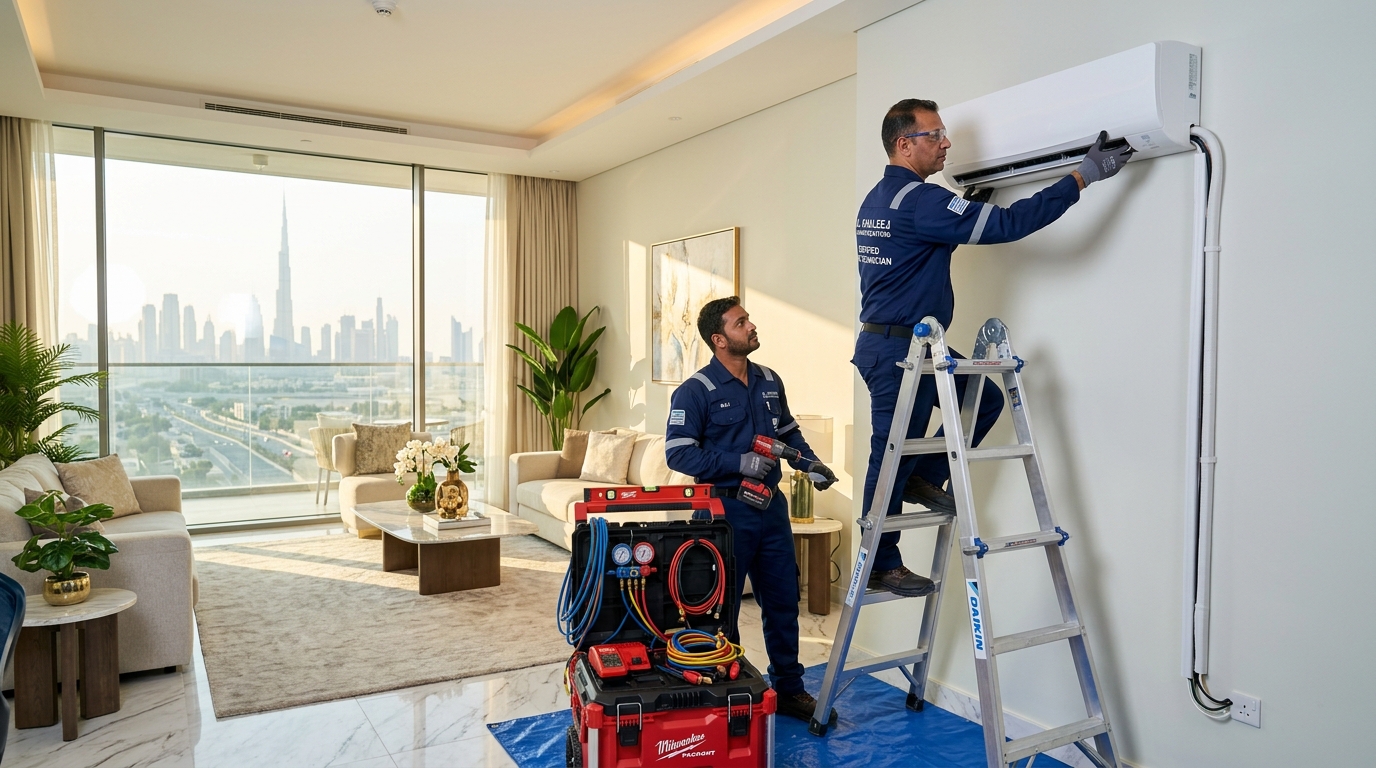
In ultra-luxury developments such as Dubai Hills Estate, Palm Jumeirah Signature Villas, Al Barari, Emirates Hills, and Jumeirah Golf Estates, architectural requirements forbid noisy, cluttering rooftop package units or dozens of individual split AC condensers. Instead, architects install advanced Variable Refrigerant Flow (VRF) and Variable Refrigerant Volume (VRV) systems.
A single high-capacity outdoor modular unit (such as a Daikin VRV IV/V, Mitsubishi Electric City Multi, or LG Multi V 5) connects through an intricate network of brazed copper refnet headers to 8, 12, or even 24 concealed ceiling indoor units. Rather than switching compressors on and off, the system modulates inverter motor frequencies from 15 Hz to 120 Hz, matching refrigerant delivery precisely to the micro-thermal demands of each bedroom, majlis, or wine cellar.
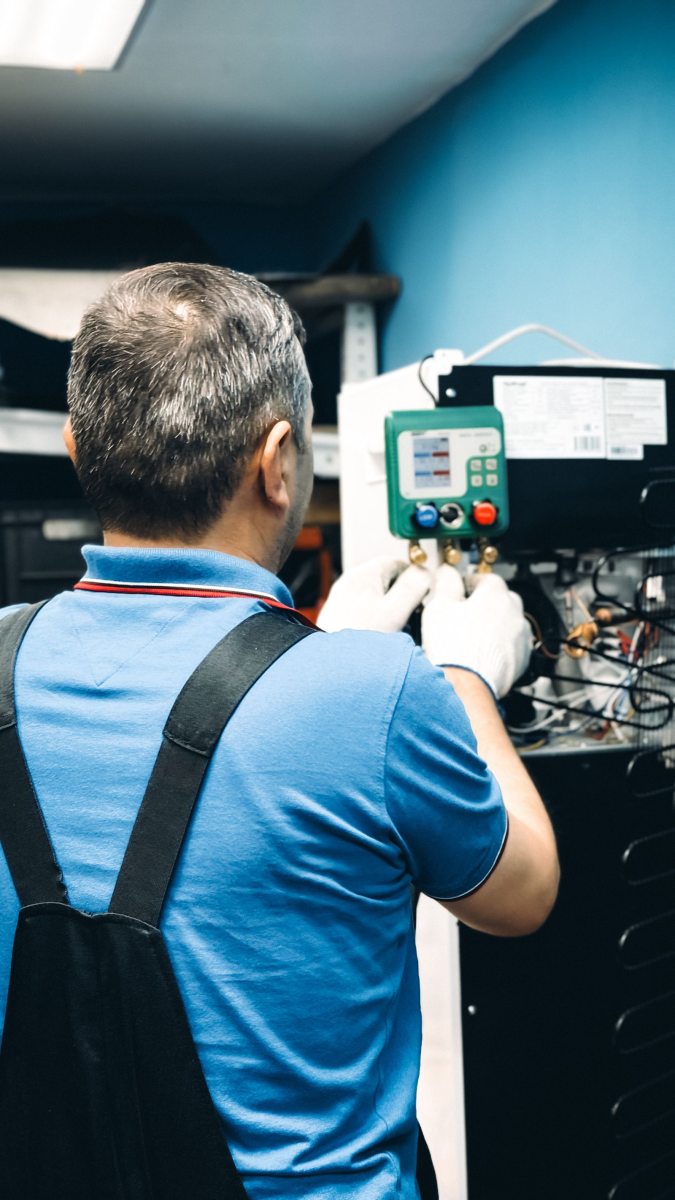
However, when a VRF system malfunctions, a traditional AC repairman equipped only with manifold gauges and contactors will quickly find themselves out of their depth. VRF maintenance demands senior diagnostic technicians trained in microprocessor telemetry, electronic expansion valves, DC bus circuits, and refrigerant oil management.
2. Electronic Expansion Valve (EEV) Diagnostic & Jamming Issues
In a VRF network, each indoor ducted unit contains an Electronic Expansion Valve (EEV) instead of a fixed capillary tube or thermal expansion valve. The EEV employs a 12V DC bipolar stepper motor driving a needle valve across 0 to 480 discrete micro-steps.
Common Failure Modes in Dubai:
- Valve Seizing from Brazing Oxide Flakes: If original villa installers brazed copper refnet joints without continuous dry nitrogen purging (0.02 MPa), copper oxide scale flakes peel off inside the lines. These micro-particles migrate into the microscopic orifice of the EEV, jamming the needle permanently open or closed.
- Stepper Motor Coil Burnout: Condensation leaks inside the ceiling can drip onto the EEV magnetic coil housing, short-circuiting the windings. A technician measures resistance across the 5-pin or 6-pin connector; normal resistance should measure balanced at 46 Ω ± 3 Ω across each phase. Any open circuit or imbalance signifies a blown coil.
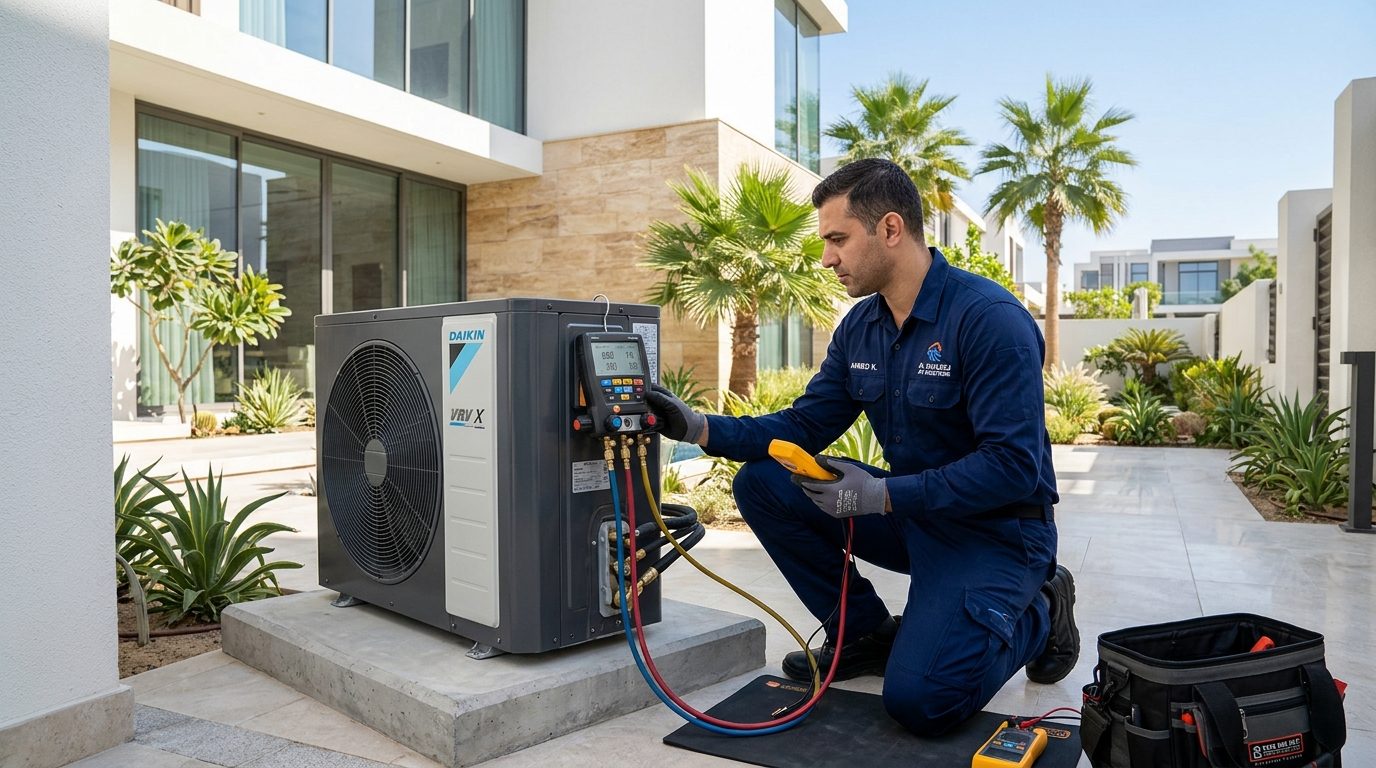
If one bedroom in your Dubai Hills villa is blowing warm air while adjacent bedrooms are freezing cold, the issue is almost never refrigerant shortage - it is a jammed closed EEV valve on that specific indoor unit. Inspecting the subcooling and superheat telemetry via manufacturer diagnostic software (e.g., Daikin Service Checker) will confirm the exact step count command versus actual refrigerant delta-T.
3. Inverter Power Module (IPM) & PCB Failure from Voltage Spikes
The beating heart of a VRF condensing unit is the Inverter Power Module (IPM), a high-frequency solid-state bridge utilizing Insulated Gate Bipolar Transistors (IGBTs). The IPM rectifies 400V 3-phase AC DEWA incoming mains voltage into a 560V DC bus, then synthesizes variable-frequency pulse-width modulated (PWM) AC power to drive the scroll compressor.
During Dubai’s extreme summer heatwaves, localized electrical grid fluctuations, lightning transients, or phase unbalances can trigger catastrophic IGBT short-circuits. Furthermore, if thermal paste between the IPM heat sink and the outdoor chassis dries out under 50°C ambient temperatures, the inverter board overheats and shuts down on thermal self-protection.
Specialized PCB Diagnostic Steps:
- Discharge high-voltage DC bus filter electrolytic capacitors safely using a 100W resistor probe.
- Measure diode drop values across the six internal IGBT transistors using a digital multimeter on diode test mode (nominal drop: 0.35V to 0.55V).
- Inspect PCB surface-mount varistors (MOVs) and ceramic fuses for catastrophic surge ablation.
- Re-apply high-grade zinc-oxide thermal grease before remounting replacement inverter boards.
4. Communication Bus (Daikin, Mitsubishi, LG) Fault Matrix
VRF systems continuously exchange hundreds of serial data packets every second between indoor fan coils, remote controllers, and outdoor master/slave units. A communication interruption triggers emergency system shutdowns.
| Brand | Error Code | Engineering Diagnostic Description | Action Required |
|---|---|---|---|
| Daikin VRV | U4 | Transmission error between indoor units and outdoor unit (F1/F2 bus failure) | Inspect F1/F2 daisy-chain wiring, verify 16V DC bus voltage, replace faulty transmission transceiver IC |
| Daikin VRV | A3 | Indoor drain level abnormal (condensate float switch open circuit) | Flush clogged condensate line, test internal lift pump, clean pan slime |
| Daikin VRV | LC | Transmission malfunction between outdoor inverter PCB and main control PCB | Inspect harness connectors, check DC power supply board output, replace inverter board |
| Mitsubishi Electric | 6602 / 6607 | M-NET communication transmission error / bus collision | Check M-NET shielded wire grounding, verify address duplicate rotary switches on indoor PCBs |
| LG Multi V | CH05 / CH53 | Communication error between outdoor and indoor central controller | Verify communication RS-485 polarity, check termination resistors (120 Ω) |
5. Dubai Luxury Villa VRF/VRV Repair Pricing Guide (2026)
VRF system components require specialized procurement directly from authorized UAE distributor agencies (e.g., Daikin Middle East, Al Futtaim Engineering for Mitsubishi Electric). Below is our certified pricing schedule:
| Repair / Diagnostic Scope | Technical Operations Included | Estimated AED Cost | Warranty |
|---|---|---|---|
| VRF System Diagnostic Audit | Laptop connection via Daikin Checker / Mitsubishi Maintenance Tool, full telemetry data log, sensor checks | AED 450 – 750 | Full Report Included |
| EEV Valve Coil / Body Replacement | Refrigerant recovery, micro-brazing under nitrogen purge, EEV stepper replacement, evacuation to 500 microns | AED 850 – 1,600 | 12 Months Warranty |
| Inverter Main PCB / IPM Module | Original OEM inverter board replacement, DIP switch programming, thermal compound application, surge audit | AED 2,400 – 4,800 | 12 Months OEM Warranty |
| Inverter Scroll Compressor Replacement | Complete system recovery, acid burnout flush, suction & liquid drier install, deep vacuum, virgin R410A charge | AED 5,500 – 9,500 | 12 Months Warranty |
UAE Regulatory Compliance & Independent Contractor Notice
Legal Disclaimer: Technical Services Dubai operates as an independent MEP and HVAC technical contractor. References to luxury residential communities (e.g., Dubai Hills Estate, Palm Jumeirah, Al Barari, Emirates Hills, Jumeirah Golf Estates) or equipment manufacturers (e.g., Daikin, Mitsubishi Electric, LG) are made purely for descriptive and nominative identification purposes. Technical Services Dubai is an independent service company and is not officially contracted by, partnered with, or endorsed by Emaar Properties PJSC, Nakheel PJSC, or equipment manufacturers. All works conform strictly to Dubai Municipality HVAC standards and DEWA electrical regulations.
Related Technical Services in Dubai
Looking for licensed professional assistance for this issue? Connect directly with our certified technical teams:
Scope varies by unit type, access and condition. Send photos and get a fixed, itemised AC Services quotation - free, no obligation.
Frequently asked questions
What is the main difference between VRF and VRV air conditioning? +
VRV (Variable Refrigerant Volume) is a patented trademark of Daikin, who invented the technology in 1982. VRF (Variable Refrigerant Flow) is the generic engineering term used by all other manufacturers (Mitsubishi Electric City Multi, LG Multi V, Toshiba, Samsung). Both systems operate identically by modulating DC inverter compressor speeds and pulsing electronic expansion valves (EEVs) to deliver precise cooling to multiple indoor zones simultaneously.
What causes the Daikin VRV U4 error code in Dubai villas? +
The Daikin U4 error code signifies a transmission failure between the outdoor condensing unit and the indoor fan units on the F1/F2 communication bus. In Dubai villas, this is frequently caused by power surge damage on the outdoor main PCB, loose terminal connections, or electromagnetic interference from improperly routed non-shielded communication cables.
How can a stuck Electronic Expansion Valve (EEV) be diagnosed? +
An EEV uses an electronic stepper motor (0 to 480 pulses) to meter refrigerant. When stuck closed, the indoor unit blows room-temperature air while suction pipe temperature spikes. When stuck open, liquid refrigerant floods back to the outdoor unit, causing coil frost and low superheat. Technicians verify EEV coil resistance (typically 46 Ohms across coil phases) and test the stepper motor with magnetic pulse tools.
Can third-party smart thermostats (Nest, Ecobee) be connected to a VRF system? +
Not directly. Standard smart thermostats use 24V relay switching (on/off), whereas VRF indoor units communicate digitally via proprietary 2-wire serial buses. Connecting a Nest or Ecobee requires a dedicated manufacturer VRF interface adapter (e.g., Daikin DTA112A51 or CoolAutomation CoolMasterNet) to translate proprietary protocol commands without disabling inverter efficiency.