Dubai apartment owners and tenants on district cooling (Empower, Tabreed, Emicool) often experience shocking utility bills due to "Low Delta-T" surcharges and uncalibrated BTU meters. If your chilled water enters your FCU at 6°C and exits at only 8°C (Delta-T of 2°C instead of the contractually required 5.5°C to 8°C), your FCU is passing vast volumes of water without extracting heat. The primary culprits are a stuck-open 2-way actuator valve, scaled FCU heat exchanger coils, or an uncalibrated ultrasonic flow meter. Addressing these issues with valve calibration and coil descaling routinely cuts cooling consumption by 25% to 40%.
- 1. How Empower, Tabreed & Emicool Calculate Your Monthly Bill
- 2. The "Low Delta-T" Trap: Why Water Flow Without Cooling Multiplies Charges
- 3. Stuck FCU Actuator Valves: The 24/7 Invisible Meter Spin
- 4. Coil Biofilm & Mineral Scaling: Chilled Water Heat Transfer Loss
- 5. District Cooling Energy Audit & Valve Calibration Pricing (2026)
- 6. UAE Regulatory Compliance & Independent Contractor Notice
1. How Empower, Tabreed & Emicool Calculate Your Monthly Bill
For thousands of apartment owners and tenants across Business Bay, Downtown Dubai, Dubai Marina, Jumeirah Beach Residence (JBR), Jumeirah Lakes Towers (JLT), and DIFC, monthly district cooling bills from utility providers like Empower, Tabreed, and Emicool represent one of the largest housing expenses - often exceeding AED 1,000 to AED 2,500 per month during summer.
A residential district cooling bill consists of two separate charges:
- Capacity Charge (Fixed Demand Fee): A quarterly or monthly fee calculated based on the contracted cooling tonnage allocated to your apartment (typically AED 750 per refrigeration ton per year). This charge is fixed regardless of whether your AC is turned on or off.
- Consumption Charge (Variable Energy Fee): The actual thermal energy your apartment extracts from the district chilled water network, measured in Refrigeration Ton-Hours (RT-hr) by a dedicated ultrasonic BTU Meter installed in your ceiling or service corridor.
- Meter Maintenance & Fuel Surcharges: Ancillary utility administrative fees and fuel adjustment tariffs.
2. The "Low Delta-T" Trap: Why Water Flow Without Cooling Multiplies Charges
The mathematical equation governing your BTU meter is based on thermodynamic enthalpy:
Where ΔT (Delta-T) is the temperature difference between the supply chilled water entering your apartment ($T_{supply} \approx 5.5^\circ\text{C}$ / $42^\circ\text{F}$) and the return water returning to the central plant ($T_{return}$).
District cooling plants are designed to operate at a ΔT of 7.0°C to 8.5°C (water returns at 13°C–14°C after picking up heat from your apartment). If your FCU heat exchanger coils are coated in dust or your 2-way valve is malfunctioning, water rushes across the coils too fast, returning at 7.5°C (a ΔT of only 2.0°C). Because the water extracted almost zero heat, your apartment stays warm. Your thermostat keeps the valve wide open, pulling immense volumes of water through the meter. The BTU meter records massive gallons, and district cooling providers levy heavy "Low Delta-T surcharges" on your bill.
3. Stuck FCU Actuator Valves: The 24/7 Invisible Meter Spin
The single greatest cause of mysteriously exorbitant Empower and Tabreed bills is a mechanical failure of the FCU actuator valve. When an actuator valve gear strips or its synchronous motor burns out in the open position, chilled water flows through your apartment 24 hours a day, 365 days a year - even when you travel abroad on vacation or switch off your thermostat!
A single 2-way valve stuck open can pass 3 to 6 gallons of chilled water every minute. Over 30 days, this translates to over 150,000 gallons of unneeded chilled water clocked on your BTU meter, producing bills between AED 1,500 and AED 3,000 for an empty apartment.
Upgrading to a high-torque, spring-return commercial actuator (such as a Belimo or Honeywell Modulating Actuator) guarantees that the moment the room reaches setpoint temperature, the valve snaps tightly shut with zero bypass leakage.
4. Coil Biofilm & Mineral Scaling: Chilled Water Heat Transfer Loss
Chilled water circulating in district cooling distribution pipes contains suspended magnetite sludge, rust particles, and dissolved minerals. If your FCU Y-strainer is clogged or internal coil copper tubes have accumulated a 0.5 mm layer of scale, thermal conductivity plummets by 40%.
Our HVAC engineering team restores maximum Delta-T efficiency through:
- Dual-Probe Electronic Delta-T Verification: Measuring exact supply and return temperatures across each FCU using calibrated digital immersion thermometers.
- Strainer Sludge Purging: Removing black iron oxide slurry from the line Y-strainer to restore full water flow velocity.
- Dynamic Balancing Valve (PICV) Tuning: Adjusting Pressure Independent Control Valves (PICVs) to ensure water flow cannot exceed the design GPM rating even under high building header pressures.
5. District Cooling Energy Audit & Valve Calibration Pricing (2026)
Transparent pricing for district cooling audits, actuator retrofits, and Delta-T optimization across Dubai:
| Engineering Service | Scope & Deliverables | Typical AED Range | Expected Bill Savings |
|---|---|---|---|
| Comprehensive BTU & Delta-T Audit | Ultrasonic flow check, supply/return ΔT thermal analysis, BTU meter accuracy test, leak audit | AED 350 – 550 | Identifies 20%–45% billing errors |
| Belimo / Honeywell Actuator Replacement | Original OEM spring-return actuator motor, precision valve body calibration, zero-leak test | AED 450 – 750 / valve | Cuts 24/7 phantom consumption instantly |
| Y-Strainer Flush & Coil Chemical Descaling | Isolation of chilled water line, stainless mesh filter cleaning, chemical foaming coil wash | AED 280 – 450 / FCU | Restores optimal 7.5°C Delta-T |
| Turnkey District Cooling Optimization Pack | Whole-apartment overhaul: 2 to 3 actuator replacements, strainer cleaning, smart thermostat calibration | AED 1,200 – 1,800 | Average AED 400–800/month bill drop |
UAE Regulatory Compliance & Independent Contractor Notice
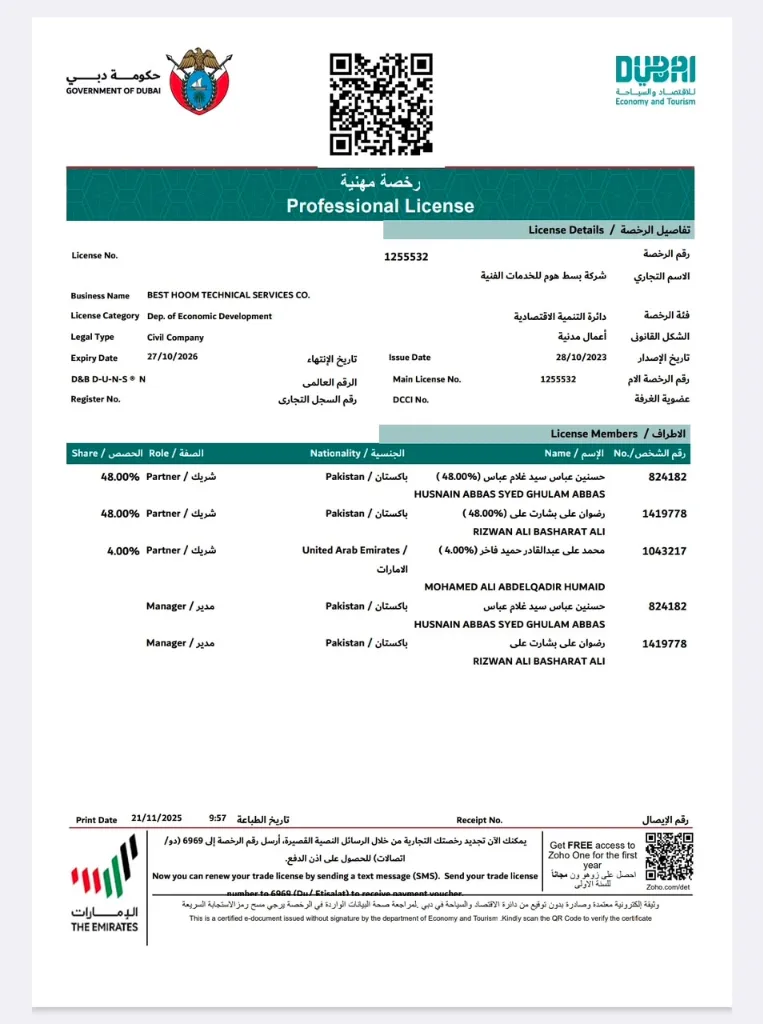
Legal Disclaimer: Technical Services Dubai operates as a licensed independent MEP and HVAC technical maintenance contractor. Mentions of district cooling utility entities (e.g., Empower, Tabreed, Emicool) or master developers are made solely for geographical, technical, and nominative identification purposes. Technical Services Dubai is an independent private enterprise and is not affiliated with, endorsed by, or under contract with Emirates Central Cooling Systems Corporation (Empower), National Central Cooling Company PJSC (Tabreed), or Emicool LLC. All chilled water line interventions strictly adhere to building strata management rules, DEWA safety regulations, and Dubai Municipality standards.
Scope varies by unit type, access and condition. Send photos and get a fixed, itemised Chiller Ac Repair quotation - free, no obligation.
Frequently asked questions
How does an Empower or Tabreed BTU meter calculate my bill? +
A district cooling BTU meter measures two real-time variables: chilled water volume (via an ultrasonic flow meter) and temperature difference (Delta-T) between supply water entering your apartment and return water exiting. The formula is: Cooling Energy (RT-hr) = Water Flow Rate x (T_return - T_supply). You are billed for both capacity charges (fixed annual fee per refrigeration ton) and consumption charges (energy actually consumed).
What is "Low Delta-T" and why does it inflate my district cooling bill? +
Delta-T is the temperature difference between incoming chilled water (typically 5.5°C) and outgoing return water (which should be 12°C to 14°C, giving a Delta-T of ~7°C). If your FCU coil is dirty or your actuator valve is stuck open, water rushes through without absorbing heat, returning at 7°C (Delta-T of 1.5°C). The utility meter registers massive water flow volume, dramatically inflating your consumption charges and triggering low Delta-T penalty tariffs.
How does a faulty FCU actuator valve cause high district cooling bills? +
When an actuator valve fails in the stuck-open position, chilled water flows through your FCU 24 hours a day, 7 days a week—even when the room thermostat is turned completely off! Thousands of liters of district cooling water circulate constantly through your apartment, driving up your BTU meter consumption around the clock.
Can Technical Services Dubai calibrate or dispute my district cooling BTU meter? +
Our certified HVAC engineers perform independent BTU audits: we clamp calibrated ultrasonic transit-time flow meters and dual immersion PT1000 temperature sensors onto your lines to verify whether the utility’s BTU meter is accurate within ±1.5%. If the utility meter is over-registering, our certified engineering report can be submitted to Empower or Tabreed for meter recalibration and billing adjustments.