When a refrigerator stops cooling in Dubai, the most common causes are a choked defrost drain freezing the evaporator fan, high ambient heat suffocating dirty condenser coils, a failed inverter start relay, or R600a/R134a refrigerant leakage. Over 95% of issues can be diagnosed and fixed on-site same-day.

Emergency Refrigerator Troubleshooting in Dubai Climate
Few domestic headaches escalate as quickly as a refrigerator that suddenly stops cooling. With Dubai summer kitchen temperatures frequently exceeding 30°C when air conditioning is set higher while residents are out, perishable groceries, dairy products, and medications can spoil in just a few hours. Understanding what causes cooling failure helps you avoid unnecessary panic and secure fast, same-day resolution.
When you need certified on-site diagnostic assistance, our mobile technicians provide rapid-response fridge repair in dubai across all communities, arriving in vans equipped with original manufacturer components.
Top 5 Reasons Your Refrigerator Has Stopped Cooling
1. Frozen Evaporator Coils (Defrost Cycle Failure)
The single most frequent symptom reported by Dubai homeowners is a freezer that remains ice-cold while the main refrigerator compartment sits at lukewarm room temperature. In modern frost-free refrigerators, cold air is produced exclusively in the freezer and blown down into the fresh food section via a motorized damper.
If the bi-metal defrost thermostat, defrost heater element, or main control board fails, thick sheets of frost encapsulate the internal cooling coil. Eventually, ice chokes the airflow duct and locks the fan blades, halting cold air circulation. A technician must test heater continuity and install an upgraded defrost sensor clip.
2. Clogged Condenser Coils (Suffocated Compressor)
Because of Dubai airborne sand and fine construction dust, the black condenser coils positioned at the bottom or rear of your refrigerator quickly accumulate a heavy felt-like blanket of lint. When heat cannot escape, the compressor overheats, trips its thermal overload protection, and shuts down periodically.
Quick DIY Check: Unplug the unit, slide it forward, and inspect the lower rear coils. If caked with grey dust, vacuuming them gently with a soft brush attachment often drops compressor running temperatures by 15°C immediately.
3. Failing Inverter Compressor or Start Relay
Do you hear an intermittent clicking sound coming from the rear of the fridge every few minutes, followed by total silence? This is the compressor start relay attempting to kick on the motor and tripping out on overload. On modern digital inverter models, power surges from lightning or local grid switching can damage the inverter PCB driver board. Professional diagnostic metering is required to verify motor winding resistance.
4. Refrigerant Micro-Leaks (R600a / R134a)
Refrigerant lines inside home appliances are hermetically sealed closed systems. Refrigerant never "runs out" through normal usage; if gas levels drop, a pinhole leak exists, typically in the vibration copper joint or moisture-prone aluminum evaporator coil. A certified technician must run nitrogen pressure testing, repair the capillary braze, pull a 500-micron deep vacuum, and weigh in factory-specified grams of refrigerant.
5. Door Gasket Magnetic Seal Degradation
Over time, cooking grease and heat degrade rubber magnetic door seals, allowing humid room air to seep in continuously. This causes intense internal condensation, water puddles beneath crisper drawers, and frost icicles inside the freezer.
Why On-Site Mobile Repair Beats Workshop Transportation
Many homeowners search for a fridge repair shop near me, assuming the heavy appliance must be loaded onto a pickup truck and transported across the city. In reality, moving a 100kg refrigerator through elevator shafts and stairwells carries substantial risks:
- Dented stainless steel doors and cracked internal tempered glass shelves
- Compressor oil draining forward into delicate capillary tubes if tilted improperly
- Delays lasting 3 to 7 days while your groceries spoil
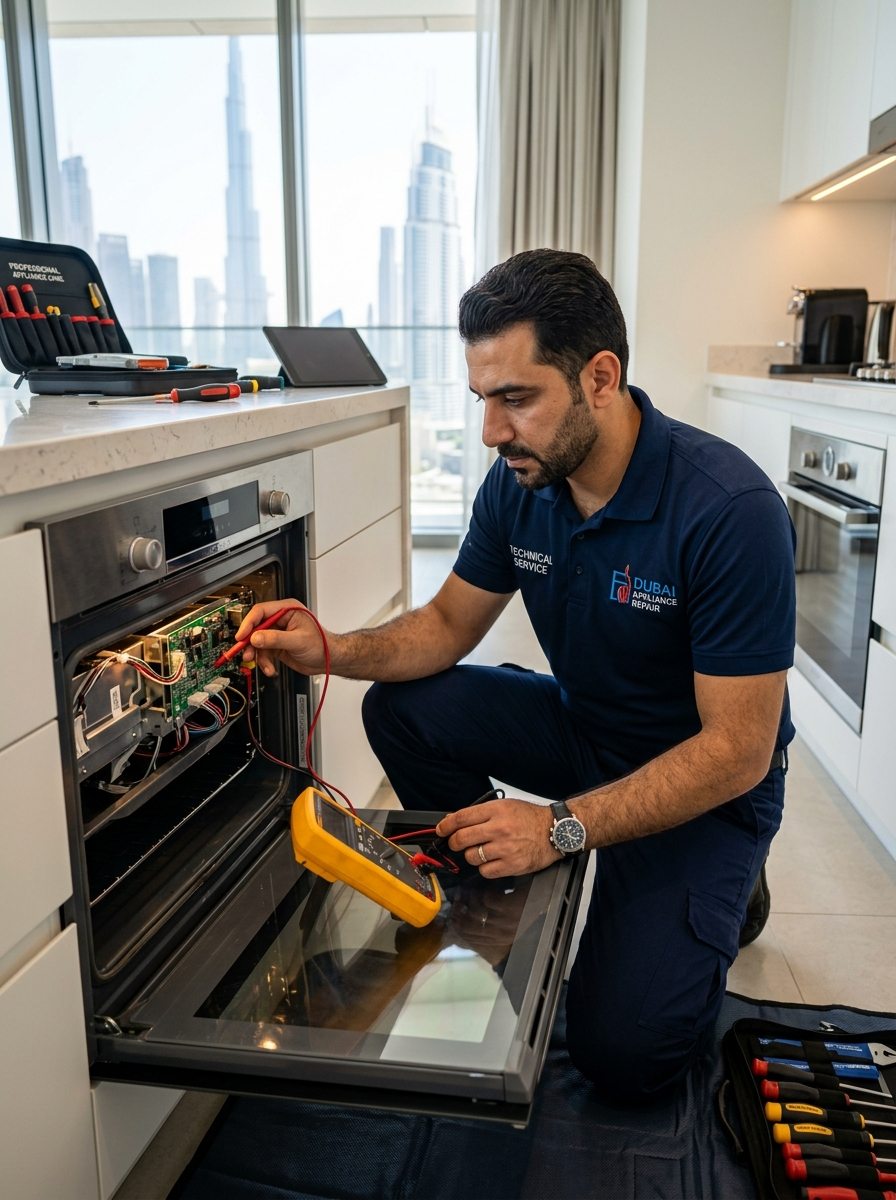
Our mobile technical vans bring certified diagnostics, OEM parts, electronic manifold gauges, and vacuum pumps directly to your kitchen. Over 95% of refrigerator repairs are completed on-site in a single 45-to-90 minute visit.
Specialized Care for Samsung & Luxury Brands
For Samsung owners experiencing Twin Cooling evaporator ice buildup or blinking display error codes (such as 22E or 25E), our dedicated Samsung fridge repair in Dubai service provides rapid troubleshooting with genuine Samsung parts. For estates in Emirates Hills or Palm Jumeirah with high-end Sub-Zero, Miele, Smeg, or Gaggenau columns, our premium fridge repair team delivers white-glove floor protection and factory-certified calibration.
Engineering Root-Cause Analysis: Dubai Environmental & Operational Factors
Operating air conditioning and district cooling infrastructure in the United Arab Emirates presents severe engineering challenges that rarely exist in moderate climates. Ambient outdoor temperatures in Dubai regularly surpass 48°C during peak summer months (June through September), creating condenser head pressures exceeding 380 PSI in standard R410A refrigeration circuits. Concurrently, coastal atmospheric humidity frequently rises above 90% across prime residential districts like Dubai Marina, Jumeirah Beach Residence (JBR), and Palm Jumeirah.
When humid ambient air is drawn across an indoor Fan Coil Unit (FCU) or evaporator coil operating with reduced airflow—typically caused by fine desert silica dust accumulation—the temperature of the evaporator drops below the dew point. This causes excessive moisture condensation, rapidly overwhelming shallow primary drain trays and causing ceiling water stains, dripping supply diffusers, or mold growth behind gypsum bulkheads.
Furthermore, in high-rise towers served by centralized district cooling providers (such as Empower, Tabreed, or Emicool), system efficiency hinges on the temperature delta (ΔT) between the chilled water supply (typically 5.5°C to 7.0°C) and the return water (targeted at 13.0°C to 15.0°C). When 2-way motorized modulating actuator valves (Belimo, Danfoss, or Honeywell) seize due to mineral scaling or internal gear wear, the chilled water bypasses heat exchange, leading to warm indoor air and inflated district cooling consumption charges.
Standard Operating Procedure (SOP): 4-Stage HVAC Diagnostic & Servicing Protocol
To ensure long-term cooling efficiency and prevent catastrophic compressor burnouts, certified HVAC technicians execute a disciplined 4-stage engineering protocol:
- Stage 1: Thermal & Digital Diagnostic Audit: Technicians inspect the unit using FLIR calibrated infrared thermal cameras to scan supply and return air diffusers, measuring temperature delta-T across the coil. Digital manifold gauges verify suction and liquid line operating pressures against factory superheat and subcooling specifications. Electrical multi-meters verify compressor running amperage (RLA) and dual-run capacitor capacitance (μF).
- Stage 2: Safe Isolation & Containment: The indoor and outdoor electrical supply is isolated via dedicated local rotary isolator switches and Lockout-Tagout (LOTO) protocols compliant with DEWA wiring regulations. For ducted split systems undergoing refrigerant repair, recovery cylinders vacuum out the charge to prevent atmospheric venting.
- Stage 3: Deep Chemical Coil Wash & Drain Jet Flushing: Technicians apply non-acidic alkaline foaming coil cleaner to dissolve hardened dirt, grease, and fungal spores lodged deep within aluminum fins. Condensate drain lines are cleared using pressurized nitrogen blasts and wet-vacuum extraction to eliminate algae blockages. Mandatory secondary drain pan float switches are inspected to guarantee automatic unit shutdown before overflow can occur.
- Stage 4: Commissioning & Airflow Balancing: The system is re-energized, blower motor bearings are lubricated, and thermostat calibration is verified. Technicians ensure the unit achieves a healthy 8°C to 12°C temperature drop across the coil before issuing a digital inspection sign-off.
2026 Transparent Cost Benchmark Guide for AC & Chiller Services in Dubai
To protect property owners, landlords, and tenants against arbitrary pricing, the table below reflects verified 2026 market benchmarks for professional HVAC repairs in Dubai:
| Service Description | Scope of Work Included | Average Market Rate (AED) | Warranty Guarantee |
|---|---|---|---|
| AC Diagnostic & Comprehensive Audit | Thermal delta-T check, gas pressure, electrical components, drain pan | AED 120 – 180 (Waived upon repair) | 30 Days |
| Chemical Coil Wash & Drain Flushing | Alkaline foam cleaning, blower wheel wash, drain line nitrogen clearing | AED 150 – 250 / unit | 90 Days |
| Chiller FCU Actuator Valve Replacement | Supply & installation of genuine Belimo or Danfoss 2-way modulating valve | AED 420 – 680 | 6 Months |
| Dual-Run Capacitor Replacement | Supply & install OEM heavy-duty run capacitor (45/5 μF or 55/5 μF) | AED 180 – 280 | 90 Days |
| R410A / R32 Refrigerant Leak Repair & Top-Up | Nitrogen pressure leak detection, copper brazing, vacuuming & gas charging | AED 250 – 550 | 90 Days |
| Secondary Drain Float Switch Retrofit | Concordia & master-developer compliant automated water safety switch | AED 250 – 380 | 1 Year |
| Villa Annual AC Maintenance Contract (AMC) | 3–4 comprehensive services/year, unlimited 24/7 breakdown callouts | AED 2,200 – 4,800 / year | Full Annual Coverage |
Dubai Regulatory & Community Compliance: Permits, Gate Passes & Working Hours
Carrying out HVAC maintenance in Dubai requires strict compliance with local developer regulations and building management security frameworks. Licensed contractors must manage the following requirements:
- Master Developer Work Permits: In master-planned developments managed by Emaar (Downtown, Dubai Hills, Arabian Ranches), Nakheel (Palm Jumeirah, JVC), or DMCC (JLT), contractors must submit commercial trade licenses, third-party liability insurance, and technician Emirates IDs through online portals (Emaar One, Nakheel NCM, Concordia) to obtain electronic gate security passes.
- Standard Community Noise & Working Hours: Non-emergency maintenance inside residential towers and villa communities is restricted to Monday through Saturday between 8:00 AM and 6:00 PM. High-noise works (such as drilling or duct cutting) are prohibited during weekends and official holidays.
- 24/7 Emergency Access Protocols: For critical breakdowns—such as complete cooling loss during summer heat, water cascading through false ceilings, or short-circuit electrical hazards—Technical Services Dubai maintains pre-approved emergency response clearance with major security gatehouses across 79 Dubai communities.
Preventative Maintenance Schedule for Dubai Residents
Proactive maintenance extends AC equipment lifespan by 5 to 8 years and lowers monthly DEWA electricity bills by up to 25%. Follow this seasonal maintenance roadmap:
- Spring Prep (March – April): Perform comprehensive chemical coil foaming, clear condensate drain lines with nitrogen, test capacitor microfarads, and inspect outdoor condenser fan motors before high temperatures arrive.
- Peak Summer Vigilance (May – September): Clean indoor air filters every 2 to 3 weeks to prevent silica dust starvation. Maintain indoor thermostat setpoints between 23°C and 25°C to avoid continuous compressor overload.
- Autumn Deep Sanitization (October – November): Inspect ductwork for mold and organic microbial growth. Perform NADCA-compliant rotary brush sanitization if stale odors or respiratory allergies appear.
- Winter Tune-Up (December – February): Check motorized bypass valves, calibrate digital thermostats, and inspect electrical distribution terminals for loose connections caused by thermal expansion.
Scope varies by unit type, access and condition. Send photos and get a fixed, itemised Appliance Repair quotation - free, no obligation.
Frequently asked questions
Why is my freezer cold but the fridge section warm? +
This indicates a failed defrost cycle (burnt defrost heater, faulty bi-metal thermostat, or defective control board) causing frost to choke the air duct between the freezer and fridge.
Can you repair my refrigerator on-site today without taking it away? +
Yes. We complete over 95% of refrigerator repairs on-site in your kitchen in a single visit, carrying OEM parts and gas charging kits in our mobile vans.
How much does refrigerator repair typically cost in Dubai? +
Standard minor repairs (relays, sensors, thermostats, fan motors) range between AED 150 and AED 380, while compressor and inverter board replacements vary by brand with upfront itemized pricing.
Do you provide a warranty on replacement parts? +
Yes. All refrigerator repair components and technician labor come with a comprehensive 90-day written warranty.
Share it with property owners, tenants, or building management in Dubai.
Our Technical Services in Dubai & All 7 UAE Emirates (24/7 Support)
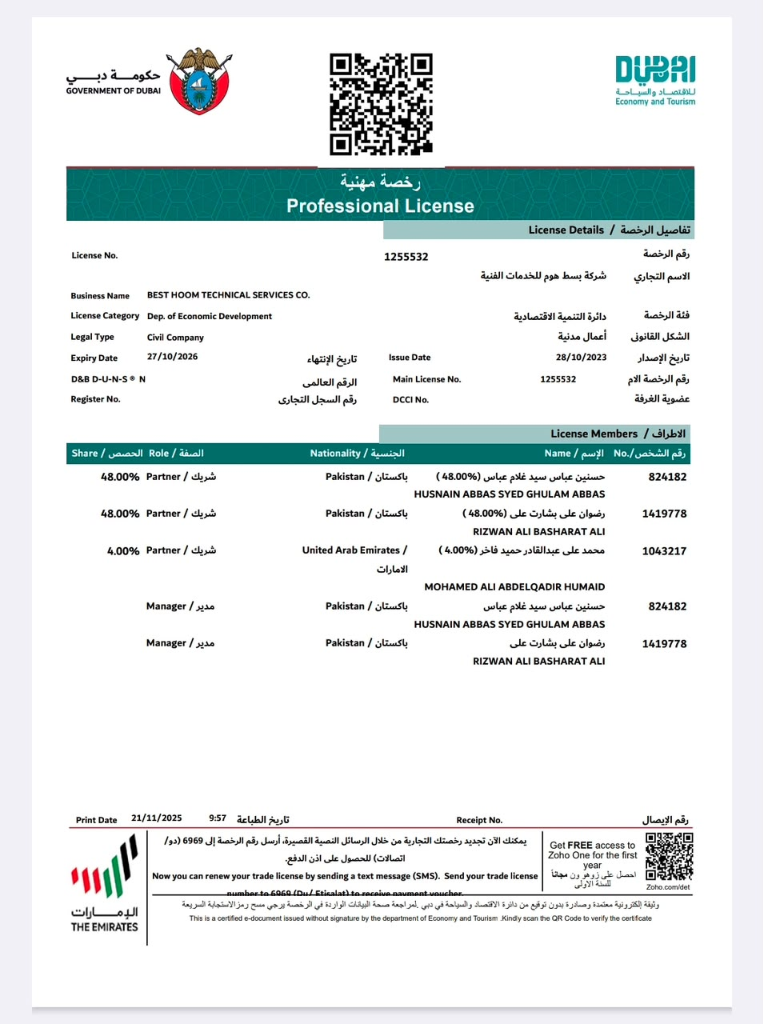
Official Technicalservicedubai (Technical Services Dubai — DET License #1255532) provides 24/7 emergency support and multi-trade maintenance across Dubai and all 7 states of the UAE.